
At this year’s Stacked Conference, the largest yet with nearly 2,000 attendees, GovTech‘s Sau Sheong captivated the audience with his talk on AI’s transformative role in coding. His presentation, titled “Coding with AI,” explored the impact of AI-powered coding tools, GovTech’s journey in adopting these technologies, and the unique challenges organizations face when integrating AI into software development.
From Spell Checkers to AI-Powered Code Completion
AI’s journey into coding began humbly, with spell checkers paving the way for code completion tools. IntelliSense, an early code completion tool, set the stage for today’s AI-driven assistants. The revolution took a giant leap in 2021 with GitHub Copilot, powered by OpenAI Codex. It brought an unprecedented level of assistance, automating parts of the coding process. The launch of ChatGPT expanded these possibilities, making it easier for developers to debug and solve coding problems on the go.
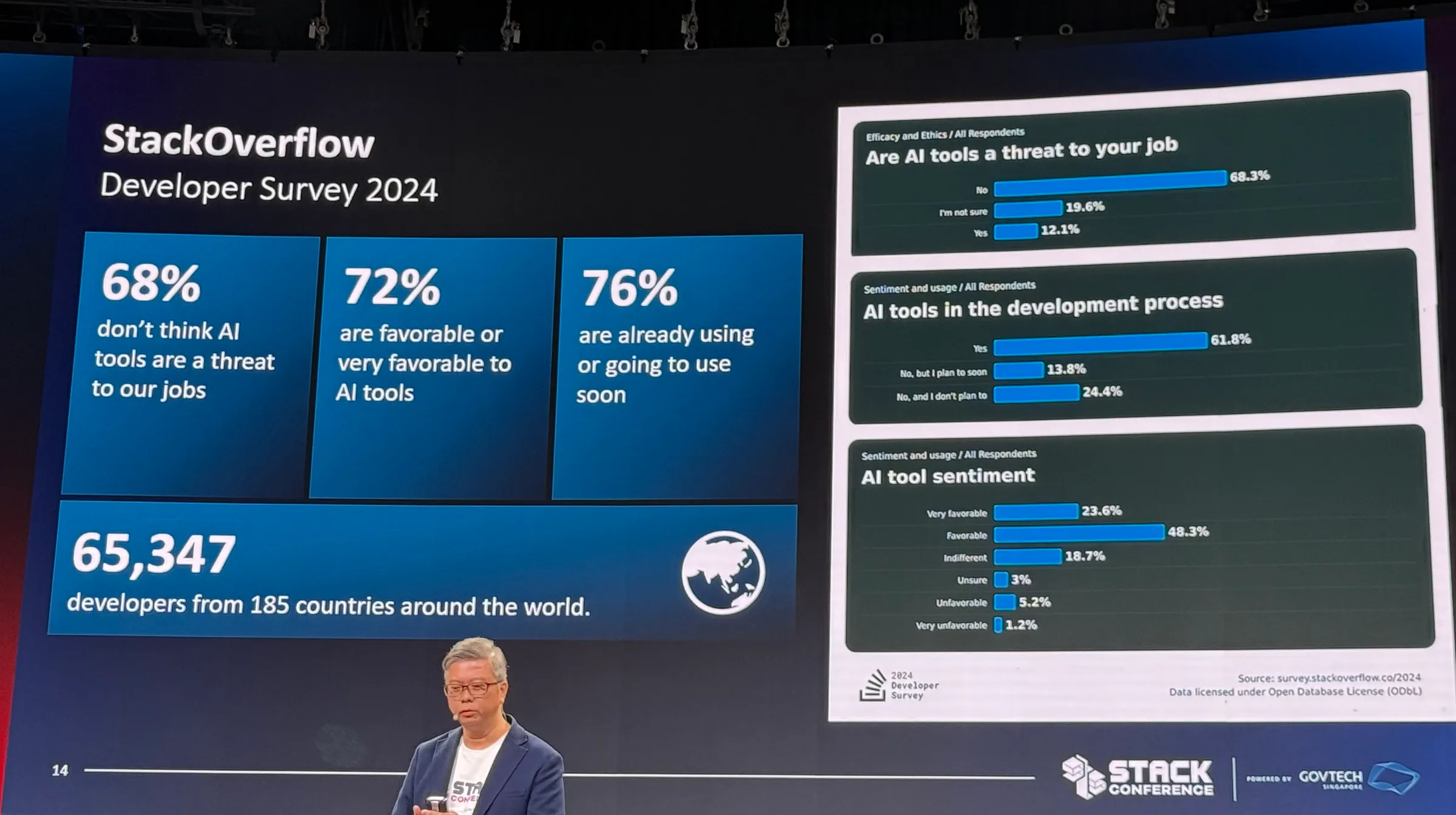
Today, developers have access to a diverse ecosystem of AI-powered tools, from integrated development environments (IDEs) with built-in AI capabilities to standalone chatbots like ChatGPT. A recent survey of 46,000 developers indicated ChatGPT’s overwhelming popularity, with 82% choosing it as their preferred AI tool. GitHub Copilot, another favorite, complements ChatGPT’s free model with its subscription service, offering deeper integration into development workflows.
Adopting AI in Enterprise Environments: A Different Game
While developers can freely experiment with AI tools, deploying them in enterprise environments involves unique considerations. Enterprises prioritize three critical aspects when adopting AI coding tools: value, security, and compliance.
- Value: Many reports estimate AI tools boost productivity by up to 50%. However, coding represents only a portion of a developer’s duties. While AI can accelerate coding, enterprises must weigh productivity gains against the broader responsibilities of their teams.
- Security: Security is paramount, especially in government settings. Data leaks via AI tools could expose sensitive projects or strategies. Companies need to ensure that AI tools align with their security protocols, often opting for models with local or on-premise deployment options.
- Compliance: Compliance is another non-negotiable, especially in regulated industries like finance and healthcare. AI tools must meet regulatory standards, ensuring they don’t introduce vulnerabilities or compromise sensitive data.
GovTech’s Pilot Program: AI in Action
To explore the feasibility of AI coding tools, GovTech ran a pilot program involving GitHub Copilot and GitLab Duo. Over four months, the 70-participant program demonstrated a 24% productivity increase. This promising result has spurred GovTech to expand AI tool adoption across government teams, with considerations for both SaaS and self-hosted models to secure data.
The Future of AI in Coding
The path forward for AI in coding may be uncertain, but the promise is undeniable. As organizations like GovTech continue to refine AI adoption strategies, developers and enterprises alike will benefit from the evolution of these powerful tools.
In an ever-evolving tech landscape, the insights from the Stacked Conference remind us that the future of coding is not about replacing developers but empowering them. AI is here to enhance productivity and make coding smarter, faster, and more secure.
Stay tuned for more exciting developments as AI redefines the coding landscape!