
An AI model can answer a question. An AI Agent can work towards a goal—when it has the right instructions, information, tools and guardrails.
AI Models, Skills, Context, Memory and Agents are terms we hear more often, but the relationships between them can be difficult to untangle. You don’t need a computer science degree to understand the basics.
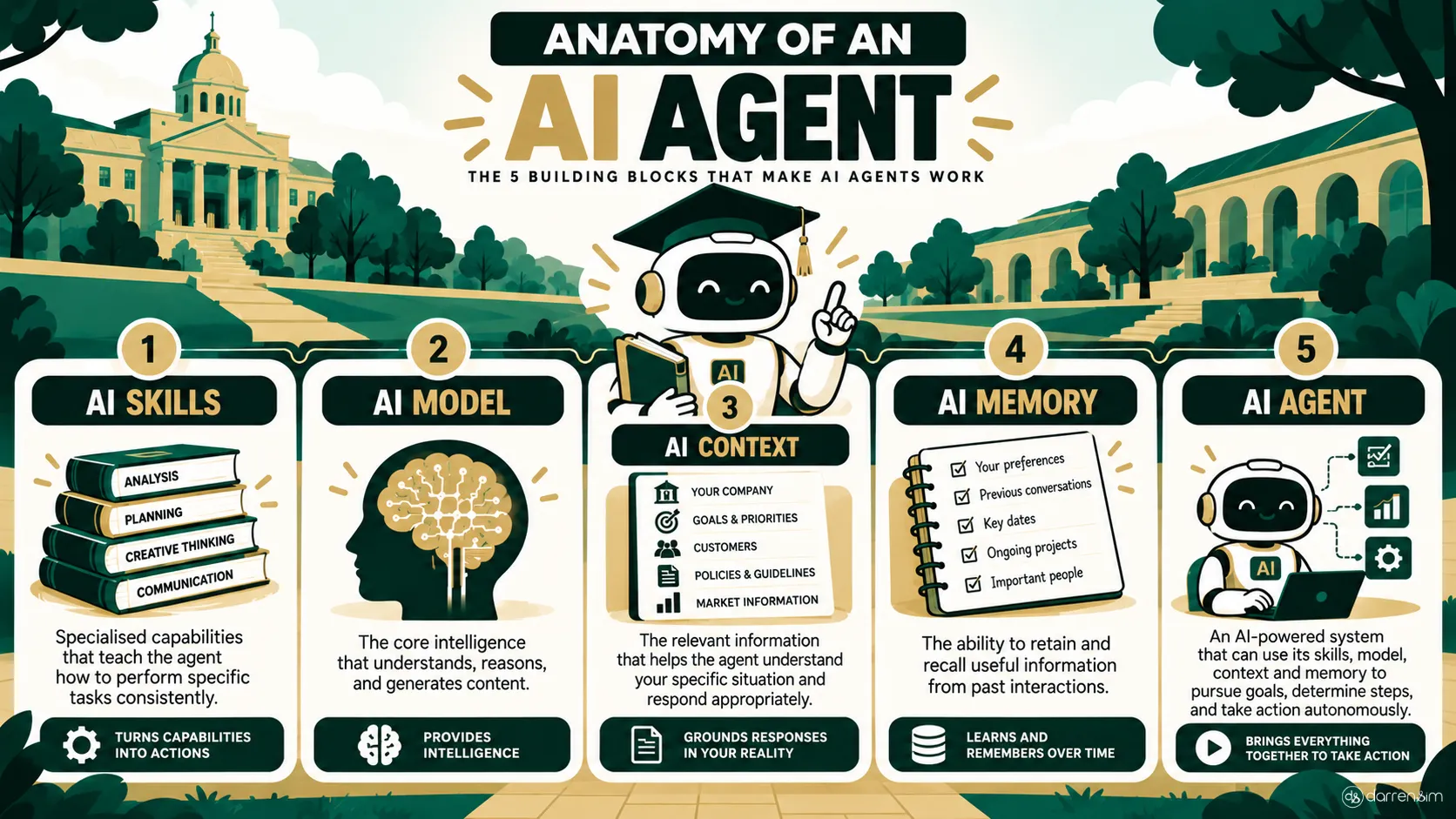
Imagine hiring a university graduate as an intern. Their intelligence matters, but they’ll also need training, an understanding of your organisation, useful resources and clear boundaries. That analogy helps explain how AI systems can move from generating answers to helping with real work.
1. The AI Model: The graduate’s brain
A graduate brings general knowledge, problem-solving ability and communication skills. An AI Model provides a system’s underlying ability to interpret information and generate responses.
Models differ. Some are versatile generalists; others are designed for more involved reasoning or for working with images, audio and other information. But intelligence alone doesn’t make someone ready to do a particular job.
A capable graduate may still not know how your organisation prepares its monthly management report. The model provides general intelligence—not, by itself, your organisation’s specific way of working.
2. AI Skills: The specialist modules and playbooks
At university, our graduate takes modules that teach specific methods and frameworks. At work, a playbook can guide them through a recurring task.
AI Skills work similarly: they are reusable instructions and supporting resources that guide an AI system through a type of work. A reporting skill, for example, could specify the preferred structure, metrics and analytical approach for a management report.
The model provides general capability. A skill provides a repeatable method for applying it.
3. AI Context: The company orientation
On their first day, our intern needs to learn about the organisation: its priorities, customers, constraints and the task at hand. AI Context is the information made available to an AI system so it can respond appropriately to its current situation.
Ask for a pricing recommendation without context and you may get generic options. Share the product’s customer segments, market position, business objectives and competitive landscape, and the advice can become more relevant.
Context helps turn general intelligence into situation-aware assistance. It may come from the conversation, documents or approved information sources. A briefing for one task does not automatically mean the system will retain it for future conversations.
4. AI Memory: The intern’s notebook
A good intern keeps track of useful information instead of asking you to repeat it every day. AI Memory can serve a similar purpose: retaining selected information from previous interactions and retrieving it when relevant.
For example, a regional sales director might want an AI assistant to remember the markets they cover and how they prefer updates to be structured. Whether—and what—the system remembers depends on how its memory is designed and configured. It should not be assumed to retain everything.
A useful distinction: context is the information available for the task at hand; memory is information retained from earlier interactions that may be recalled later.
5. The AI Agent: The intern doing the work
So far, we’ve described what the graduate knows. An AI Agent is a system that can use available intelligence and capabilities to pursue a goal, work through steps and take actions with some degree of independence.
Suppose you ask for a competitive analysis for a leadership meeting. Depending on its design and permissions, an agent might:
- Identify what it needs to find out.
- Gather information from approved sources.
- Compare the findings against your objectives.
- Draft an analysis and flag gaps or uncertainties.
- Present the result for your review.
A traditional chatbot can help brainstorm the report structure or summarise information you provide. An agent can go further by coordinating multiple steps towards the assigned objective. The distinction is not simply that one is more intelligent; it is that an agent can use its capabilities to pursue a goal and act.
The tools that let an agent act
An intern needs resources to do the job: perhaps a laptop, spreadsheets or access to company systems. AI Agents may also need tools to interact with the world beyond the model—for example, to search approved sources, read a file or update a business system.
Without suitable tools and permissions, an agent may be able to recommend an action but not carry it out. Tool access should be limited to what the task requires, with clear boundaries and human approval for consequential decisions.
Putting the pieces together
The university-graduate analogy brings the ideas together:
- The model is the brain: it provides general intelligence.
- Skills are modules and playbooks: they provide specialised instructions and methods.
- Context is the orientation: it supplies relevant information for the current task.
- Memory is the notebook: it can retain and recall selected information.
- Tools are the resources: they let the system interact with approved information and services.
- The agent is the intern at work: it coordinates available capabilities to pursue an objective.
These are not interchangeable parts, and not every agent needs every capability. The design depends on the work it is meant to support. The important point is that an agent’s actions are shaped by the model, information, instructions, tools and permissions available to it.
Why business leaders should care
The opportunity is not only to have a chatbot that answers questions faster. It is to understand how AI can support work in increasingly useful ways:
- Answer: respond to a question.
- Assist with context: use relevant business information and established methods to produce tailored help.
- Help execute: coordinate steps and perform authorised actions, with people involved where appropriate.
That progression invites a more practical question: Which business processes could benefit from AI systems that understand the objective, follow our ways of working and carry out appropriate tasks under human supervision?
Final thought
We don’t expect a new intern to succeed just because they’re intelligent. We provide training, explain the business, give them the right resources and delegate responsibility carefully.
The same principle applies to AI Agents. Intelligence is the starting point; useful outcomes depend on combining it with the right instructions, information, tools and governance.
An AI Agent is not just AI that knows things. It is AI configured to work towards getting things done.